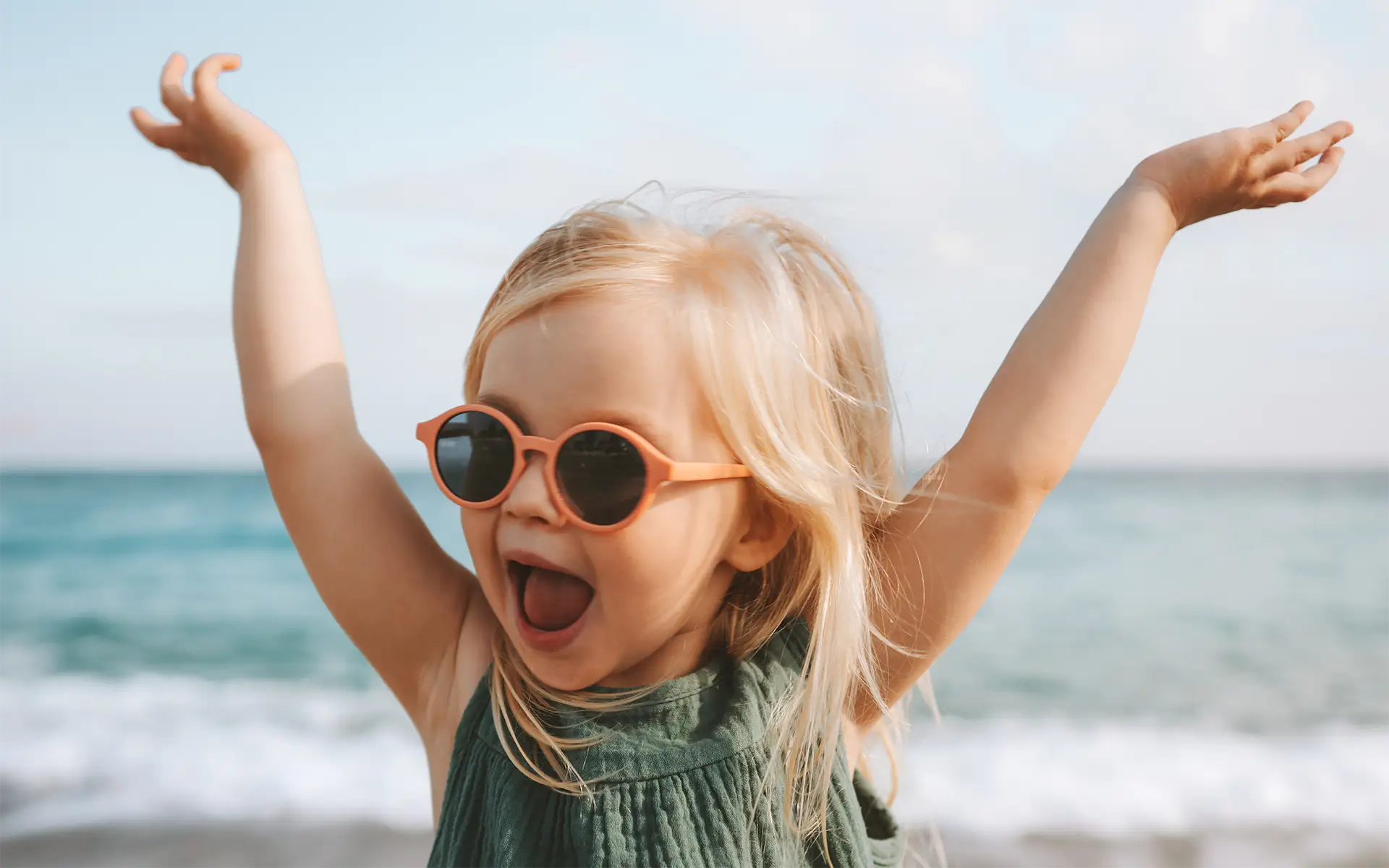
Summertime is here, and from the backyard to the beach, kids are soaking up the sun and likely not thinking about sun protection. So as you chase your little ones around with the sunscreen, keep in mind that their eyes also need protection. Yes, UV safety for kids extends beyond the skin to include their eyes, as UV’s damaging effects on vision are cumulative and begin in childhood. So before you let them out without eye protection, learn all about children’s eyes and UV exposure, its effects, and how to protect sensitive little eyes from the sun’s damaging rays.
Key Takeaways
- Why children’s eyes are more vulnerable to UV damage.
- How it can affect a child’s vision now and later in life.
- The tie between sunshine and myopia.
- Top tips for protecting your child’s eyes from UV rays.
Why Children's Eyes Are More Vulnerable To UV Damage
There are so many reasons why it’s important for children to get outside and play! Studies1 have shown that outdoor time can improve their cognitive and social-emotional development, physical health, sensory skills, attention spans, and immunity. However, all that sunshine also includes exposure to the sun’s harmful UV rays, which can be harmful to the eyes.
Because children’s eyes are still developing, their lens is actually clearer than an adult’s. Although this may sound like a good thing, it unfortunately allows more UV light to penetrate and reach their retina. Over time, repeated exposure during childhood can increase the risk of eye health issues later in life, including cataracts, macular degeneration, and even photokeratitis, which is essentially a sunburn of the eye.2,3 That’s why it’s so important to encourage and normalize UV safety for kids early. Helping them into the habit of wearing proper eye protection not only safeguards their vision now, but also teaches them healthy eye care habits for life.
How UV Exposure Damages Children's Vision
Harmful UV rays can cause vision problems in children that may affect them now or later in life. In fact, there is substantial evidence that repeated UV exposure is associated with an increased risk of cataracts, macular degeneration, photokeratitis, and pterygium.4
Cataracts
A cataract occurs when the eye’s natural lens becomes cloudy, similar to looking through a foggy window. Over time, this can make vision appear blurry, dull, or less sharp. While children are unlikely to develop cataracts, repeated exposure to UV light over the years, combined with aging and other factors, can increase the risk of developing them later in life.
Macular Degeneration
Like cataracts, macular degeneration is linked to aging and develops later in life, and prolonged UV exposure is considered a contributing risk factor. This condition affects the part of your eye responsible for sharp, central vision: the macula. Macular degeneration can make it harder to recognize faces or see fine details, such as with reading.
Photokeratitis (sunburn of the eye)
Photokeratitis is the one condition children are vulnerable to now. It’s basically a sunburn on the surface of the eye, the cornea, that occurs with strong UV exposure, whether on the beach, on the water, or in snowy conditions. It’s a temporary condition that can feel painful and cause redness, tearing, blurry vision, and sensitivity to light. These symptoms often appear within a few hours of the strong UV exposure, typically improving within 24 to 48 hours as the surface cells of the cornea naturally regenerate.
Pterygium
This condition is a growth of tissue that starts on the white part of the eye and sometimes extends onto the cornea over time. It usually resembles a small, wedge-shaped or raised patch on the eye, and its biggest risk factor is prolonged UV exposure. Pterygium is often referred to as “surfers’ eye” because it’s common among surfers and others who spend a lot of time in sunny, windy, coastal environments. In addition to a visible growth on the eye’s surface, it can cause dry eyes, irritation, redness, or a burning feeling in the eye.
The Link Between Outdoor Time, UV Exposure & Myopia In Children
You may have heard that spending time outdoors in visible, bright light can help delay or reduce the risk of myopia in children5, and that is true, with some important caveats. Nearsightedness occurs when the eye grows too long from front to back, and this occurrence in children has risen sharply over the past 30 years. Myopia affects not only vision, but it can also lead to difficulties with hand-eye coordination in children. While genetics play a role, many experts believe this increase is also linked to more screen time and less time spent outside, both of which may raise the risk of developing myopia.
It’s unclear why time spent outdoors can help prevent myopia in children who are not already myopic. However, some theorize that sunlight increases dopamine levels in the eye, which controls its growth rate. Another theory suggests that shorter viewing distances during prolonged screen time and other near-eye work without breaks, such as reading, may promote abnormal eye growth.
However, the beneficial effects of the sun are due to the visible bright light, not UV rays. So sun safety for kids should always be a priority. Being outside allows them to soak up the benefits of sunlight, but protecting vulnerable areas like eyes and skin is also essential.
How To Protect Your Child's Eyes From UV Rays

Encouraging UV safety for kids is important, but not always easy. Convincing them to wear and reapply sunscreen is a task in vigilance. Even adults often forget to apply and reapply sunscreen when outdoors! Eye protection can also be a challenge, but it’s manageable. Fortunately, options for kids’ eye protection have really evolved in recent years.
Choosing The Right Sunglasses For Kids
Sunglasses are a bright day go-to, but not all are created equal. When it comes to increasing UV safety for kids with sunglasses, look for options that offer 100% protection against UVA and UVB rays. Look for labeling with 100% UV protection, UV400, or UV40, which means they block 99-100% of UV. To ensure they actually stay on, pick comfortable sunglasses that fit right and can handle active play. They should be large enough to shield your child’s eyes from multiple angles, which is why wraparound options are quite popular. Also, consider polycarbonate lenses and rubber, flexible frames for impact resistance and durability.
If your child already wears glasses, prescription sunglasses with UV protection can help them see clearly and safely in the sun.
Wide-Brim Hats And Shade
Another great tool that supports UV safety for kids when outside is a wide-brimmed hat. They add an extra layer of protection by shading the face, which can cut the amount of harmful rays that reach your child’s eyes in half. However, shade is the ultimate UV protection. We recommend spending time in shaded areas, especially during midday when UV levels are highest.
How To Get Kids To Actually Wear Sunglasses
If your child isn’t all in on wearing sunglasses outdoors, there are some tactics you can use to encourage them and make it a routine. Leading by example is the easiest way to normalize wearing sunglasses. So, make it a family routine to always wear sunglasses on sunny days. Talking to them about why wearing sunglasses is important can also help. Explain that just like wearing sunscreen protects their skin and brushing their teeth protects their teeth, wearing sunglasses protects their eyes and keeps them healthy.
Involving them in selecting the sunglasses also helps. There are plenty of options made just for kids, featuring bright colors and character branding. Kids look forward to wearing their “favorite” things! Also, praise them every time they remember to put them on on their own.
Signs Of UV-Related Vision Problems In Children
Practicing sun safety for kids includes protecting their eyes while outdoors, but it’s not always possible. As parents, we do the best we can, but kids will be kids. Here are some signs of vision problems in children caused by excessive UV exposure: squinting, eye rubbing, redness, sensitivity to light, and blurry vision. If you notice any of these symptoms, especially if they persist or worsen, it is a good idea to schedule an eye exam. An eye doctor can identify potential concerns early and recommend the right steps to protect your child’s vision.
Healthy vision plays an important role in how children grow, learn, and interact with the world around them, from reading and hand-eye coordination to confidence in daily activities. When challenges arise, having the right support can make all the difference. At KidsCare Home Health, we provide compassionate, in-home pediatric therapy services tailored to each child’s unique needs, including physical, occupational, and speech therapy. Through early intervention and ongoing care, we help children build the skills they need to thrive in everyday life and create a strong foundation for long-term success.
Learn More or Contact Us Today!
Frequently Asked Questions
At what age should kids start wearing sunglasses?
The American Academy of Ophthalmology recommends that children begin wearing UV-protective sunglasses as early as 6 months of age.
What does 100% UV protection mean on sunglasses?
A label stating “100% UV protection” on sunglasses indicates they block 99-100% of UV rays.
Can UV exposure cause myopia in children?
No, ultraviolet exposure does not cause myopia, which is nearsightedness. Spending time outdoors in natural light can help prevent or slow the development of myopia in non-myopic children. However, prolonged exposure to the sun’s UV rays is not healthy for eyes, and practicing UV safety for kids should include wearing sunglasses outdoors.
What is photokeratitis in children?
Photokeratitis is a painful eye condition caused by exposure to ultraviolet (UV) rays, most commonly from the sun. Think of it like a sunburn that affects parts of your eye, specifically the cornea, instead of the skin. Symptoms of redness, tearing, blurry vision, and sensitivity to light typically appear within a few hours after strong UV exposure and improve within 24 to 48 hours as the corneal surface cells naturally regenerate.
How often should children have an eye exam?
The American Optometric Association recommends that infants receive a comprehensive in-person eye and vision assessment between 6 and 12 months of age. Preschoolers should receive at least one in-person, comprehensive eye exam between the ages of 3 and 5 to prevent or diagnose any condition that may have long-term effects. School-aged children (6 to 18 years) should receive a comprehensive in-person exam before entering the first grade and annually thereafter.
1 – https://news.sanfordhealth.org/childrens/play-outside/
2 – https://pubmed.ncbi.nlm.nih.gov/21617534/
3 – https://www.kadrmaseyecare.com/eye-health–care-blog/uv-eye-protection-for-kids-and-teens
4 – https://pmc.ncbi.nlm.nih.gov/articles/PMC3872277/
5 – https://www.aao.org/eye-health/news/prevent-childhood-myopia-sunshine-outdoors